Closed Tank DP Level Measurement – Wet Leg Simulator
Inputs: play with these
How the transmitter thinks (live)
Outputs
| Actual level | |
| HP side pressure | |
| LP side pressure | |
| Differential pressure (DP) | |
| Calibrated range (LRV to URV) | |
| Measured level (% of span) | |
| Measured level (mm) | |
| Output current | |
| Measurement error |
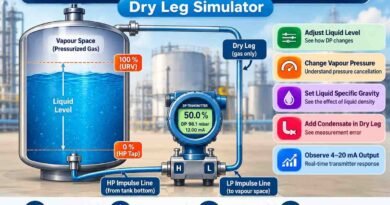
Understand how a differential pressure (DP) transmitter measures liquid level in a closed tank using the wet leg method.
In this method, the low-pressure (LP) impulse line is kept filled with a reference liquid, creating a constant hydrostatic pressure. The high-pressure (HP) side senses the tank’s liquid head along with vapour pressure, while the LP side senses vapour pressure plus the wet leg liquid head.
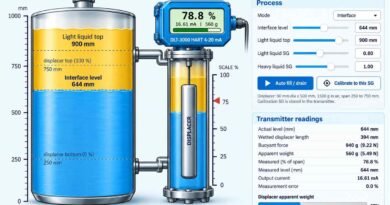
Use this interactive simulator to adjust tank level, gas pressure, process liquid specific gravity, wet leg specific gravity, and wet leg height. Observe how HP pressure, LP pressure, differential pressure, calibrated range, and 4–20 mA output change.
You can also explore how a partially drained wet leg or a change in liquid density causes measurement errors, helping you understand transmitter calibration and troubleshooting in industrial instrumentation.