H2S Gas Detector Calibration Procedure | Interactive Simulator
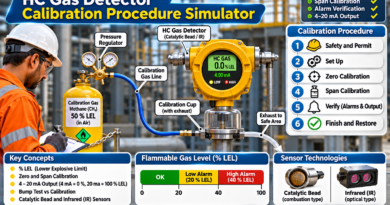
Hydrogen sulfide (H2S) is a toxic gas that is deadly in small amounts, so the fixed H2S detector must be right. Its electrochemical sensor makes a tiny current from the gas, and the transmitter shows ppm and a 4-20 mA signal (4 mA = 0 ppm, 20 mA = 100 ppm). Calibration sets zero in clean air and span with a certified gas, then checks the alarms. Follow: 1 Safety and permit, 2 Set up, 3 Zero, 4 Span, 5 Verify, 6 Finish. Normal working mode can be used at any time.
Procedure map (click a step)
Hint
1 Safety and permit
Bench settings and readings
| Detector | |
| Gas reaching the sensor | |
| Display reading | |
| Output 4-20 mA | |
| Alarms | |
| Reading stable |
Calibration summary
| As-found zero reading | |
| As-found span error | |
| As-left span error (verify) | |
| Response time T90 (limit 30 s) | |
| Sensor sensitivity (limit 50 % of new) | |
| Result |
Bump test or calibration?
| Test | What it does | When | Adjusts? |
|---|---|---|---|
| Bump test | Gas on the sensor to prove it responds and alarms | Often (before use, daily for portables) | No |
| Zero + span calibration | Sets clean-air zero and the span value with certified gas | At the interval in your procedure (for example 3 to 6 months), or after a failed bump test | Yes |
| Sensor replacement | New sensor, then full calibration | Sensitivity below 50 %, or end of life | Yes |
Toxic gas sensor technologies
| Technology | How it works | Good for | Remember |
|---|---|---|---|
| Electrochemical | Gas reacts at an electrode and makes a current | H2S, CO, Cl2 at ppm level | Wears out in 2 to 3 years; cross-sensitivity |
| Metal oxide semiconductor | Gas changes the resistance of a heated film | Low cost, wide range | Drifts; reacts to other gases |
| Lead acetate tape | Tape darkens in H2S | Very low levels (ppb) | Consumable tape, slow |
| Open-path laser | Light absorption across a path | Large areas, fast | Higher cost |
What to remember
H2S Gas Detector Calibration Procedure – Interactive Simulator
Hydrogen Sulphide (H₂S) is one of the most dangerous toxic gases found in oil and gas plants, refineries, wastewater treatment facilities and other industrial areas. Even at relatively low concentrations, it can affect human health. At higher concentrations, exposure can become life-threatening.
Because of this, proper installation, testing and calibration of fixed H₂S gas detectors is very important. A detector should respond correctly when gas is present and send the right signal to the control system.
This H2S Gas Detector Calibration Procedure Simulator is designed to help instrumentation technicians and engineers understand how zero calibration, span calibration, alarm verification and 4–20 mA output checking are performed.
You can practise the complete calibration sequence in an interactive environment and observe how the detector reading changes when different gases and sensor faults are applied.
What is an H₂S Gas Detector?
An H₂S gas detector is a safety instrument used to detect hydrogen sulphide concentration in the surrounding atmosphere. Fixed detectors are commonly installed near pumps, compressors, process equipment, gas handling areas and other locations where H₂S leakage may occur.
Most conventional fixed H₂S detectors use an electrochemical sensor. When H₂S enters the sensor, a chemical reaction takes place at the electrodes and generates an electrical current proportional to the gas concentration.
The transmitter converts this signal into a concentration reading, usually expressed in ppm (parts per million).
A typical 4–20 mA output range may be configured as:
- 4 mA = 0 ppm
- 12 mA = 50 ppm
- 20 mA = 100 ppm
These values are only an example. Actual measuring range and output configuration should always be checked from the detector datasheet.
What is Zero Calibration?
Zero calibration is the process of adjusting the detector to indicate zero ppm when it is exposed to clean air or an approved zero gas.
Over time, sensor ageing, environmental conditions and other factors can cause zero drift. For example, a detector may indicate 2 or 3 ppm even when there is no H₂S present.
During zero calibration, the technician applies the approved zero gas, waits until the reading becomes stable and performs the zero adjustment according to the manufacturer’s instructions.
What is Span Calibration?
Span calibration checks the detector response against a known concentration of H₂S calibration gas.
For example, if the certified calibration cylinder contains 25 ppm H₂S, the detector should respond to that concentration within its specified accuracy.
The general process is:
- Connect the calibration gas cylinder using the correct regulator and tubing.
- Fit the calibration adapter or gas calibration cup.
- Apply the certified H₂S gas at the manufacturer’s recommended flow rate.
- Allow the sensor reading to stabilise.
- Adjust the span value if required.
- Remove the gas and confirm the detector returns to its normal condition.
Always enter the concentration printed on the calibration cylinder. Using an incorrect span value can result in an inaccurate detector reading.
Step-by-Step H₂S Gas Detector Calibration Procedure
1. Safety and permit
Before starting calibration, obtain the required work permit and inform the control room. Follow the site’s gas detector maintenance procedure.
- Wear a suitable personal H₂S monitor.
- Check the calibration gas cylinder and its expiry date.
- Confirm the correct regulator and calibration accessories.
- Arrange a safe exhaust location for the calibration gas.
- Follow the approved procedure for inhibiting alarm or trip outputs.
Never rely on smell to identify H₂S. At dangerous concentrations, the sense of smell can become unreliable.
2. Calibration setup
Check the calibration cylinder concentration, gas flow requirement and detector configuration.
For this simulator, the example cylinder contains 25 ppm H₂S and the target flow is 0.5 L/min with a tolerance of ±0.1 L/min.
These are training values only. Always follow the actual detector manufacturer’s requirements.
3. Zero calibration
Apply clean air or approved zero gas to the detector. Wait until the reading becomes stable before performing zero adjustment.
Record the as-found reading before making any adjustment. This information is useful for maintenance history and identifying sensor drift.
4. Span calibration
Apply the certified H₂S span gas through the calibration cup.
Wait until the detector reading stabilises and perform the span adjustment. Check whether the displayed value corresponds to the certified gas concentration.
5. Alarm and output verification
After calibration, verify the detector response and associated outputs.
The simulator uses the following example alarm settings:
- Low alarm: 10 ppm
- High alarm: 20 ppm
Also check the 4–20 mA output, alarm indication and response time. Actual alarm setpoints and response limits depend on the plant safety philosophy and approved instrument configuration.
6. Finish and restore
After completing the calibration:
- Stop the calibration gas supply.
- Remove the calibration cup and accessories.
- Confirm the reading returns to the expected clean-air value.
- Remove the alarm and trip inhibit as authorised.
- Inform the control room that the detector is back in service.
- Complete and sign the calibration report.
Do not leave a detector isolated or inhibited after maintenance work.
How to Use the H₂S Gas Detector Calibration Simulator
This interactive simulator allows you to practise the calibration sequence without connecting a real detector or handling calibration gas.
Follow these steps:
- Start with the safety and permit checklist.
- Select the span gas concentration and adjust the gas flow.
- Switch ON the detector and allow it to warm up.
- Select clean air or zero gas and perform zero calibration.
- Apply span gas and wait for a stable reading.
- Perform span calibration.
- Observe low and high alarm indications and the 4–20 mA output.
- Complete the final restoration checklist.
- Select Normal Working Mode to simulate different H₂S concentrations.
You can also select different practice faults to understand how sensor problems affect the detector.
What Happens When a Sensor Has a Fault?
In actual plant operation, a detector may develop different problems due to ageing, contamination, environmental conditions or sensor degradation.
The simulator includes two practice faults:
Zero drift: The detector shows an additional 3 ppm reading, even when clean air is applied. This helps demonstrate why zero calibration is necessary.
Weak or slow sensor: The sensor response becomes slower and its sensitivity is reduced. A weak sensor may fail to meet the required response or accuracy criteria.
Calibration cannot repair a damaged or exhausted sensor. If the sensor fails the manufacturer’s acceptance criteria, replacement may be necessary.
Bump Test vs Calibration
These two activities are often confused, but they have different purposes.
Bump test: A small quantity of test gas is applied to confirm that the detector responds and the required alarm or indication operates. It does not normally adjust the detector reading.
Calibration: The detector is checked against a known gas concentration and adjusted when necessary to meet its specified accuracy.
A bump test should not be treated as a replacement for calibration. Follow the inspection and calibration frequency defined by the manufacturer and site procedure.
Types of Toxic Gas Detector Technologies
Different gas detection technologies are used depending on the gas, concentration range and application.
- Electrochemical sensor: Commonly used for detecting H₂S, CO and other toxic gases at ppm concentrations.
- Metal oxide semiconductor: Uses changes in electrical resistance to detect certain gases. It can be affected by temperature, humidity and other gases.
- Lead acetate tape: Uses a chemical reaction that changes the colour of the tape in the presence of H₂S.
- Open-path laser: Uses light absorption across a defined measurement path for suitable gas applications.
Electrochemical detectors are widely used for fixed H₂S detection, but the correct sensor technology must be selected according to the application.
Why Is Regular H₂S Detector Calibration Important?
A gas detector is part of the plant’s safety protection system. An incorrect reading can result in delayed leak detection or unnecessary alarms.
Regular testing and calibration help to:
- Maintain reliable gas detection.
- Identify zero drift and sensor degradation.
- Verify alarm operation.
- Confirm the 4–20 mA signal.
- Identify slow sensor response.
- Maintain calibration and maintenance records.
- Improve confidence in the plant gas detection system.
Who Should Use This Simulator?
This simulator is useful for:
- Instrumentation technicians.
- Instrumentation maintenance engineers.
- Gas detection system engineers.
- Oil and gas maintenance personnel.
- Refinery and petrochemical engineers.
- Instrumentation students and freshers.
- Engineers preparing for instrumentation interviews.
Conclusion
Understanding H₂S gas detector calibration is an important part of instrumentation maintenance, particularly in oil and gas and refinery environments.
Knowing the difference between zero calibration, span calibration and bump testing helps technicians perform maintenance more systematically. Equally important is checking the alarm response, analogue output and restoring the detector to service after the work.
Use this simulator to practise the calibration sequence and understand how different sensor conditions affect detector performance.
Training disclaimer: This simulator is for educational purposes only. It does not replace an approved site procedure, certified calibration equipment, manufacturer instructions, permit requirements or competent-person supervision. H₂S is highly toxic. Never attempt calibration on live equipment without following the required safety controls.