Air-to-Close Control Valve – Fail-Open Animation
Process control
Air-to-Close Control Valve
More air closes the valve. Lose the air and the spring opens it.
Air-to-Close Control Valve Working Principle – Interactive Animation
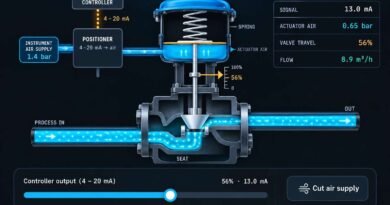
Understand how an air-to-close pneumatic control valve works using this interactive animation. Adjust the controller output from 4–20 mA and observe how actuator air pressure moves the valve plug toward the seat, reducing the valve opening.
The animation also demonstrates what happens when the instrument air supply fails. The actuator spring opens the valve, illustrating the fail-open (FO) action.
Key Features
- Interactive air-to-close control valve animation.
- Controller output adjustment from 4–20 mA.
- Visual representation of actuator air pressure and valve travel.
- Animated process flow through the valve.
- Air supply failure simulation showing spring-driven opening.
- Full-screen mode for easier viewing.
How It Works
In an air-to-close control valve, increasing actuator air pressure moves the valve plug toward the seat and reduces the valve opening. When the air supply is lost, the actuator spring moves the plug away from the seat, opening the valve.
This arrangement is commonly described as air-to-close, spring-to-open, fail-open.
Engineering Note
This simulator is intended for learning and conceptual understanding. Actual valve travel, flow rate, actuator pressure, and failure response depend on the valve characteristic, actuator design, positioner configuration, process conditions, and manufacturer data. The displayed values are illustrative, not validated sizing calculations.